Sunday, May 22, 2011

Week 7. The Seventh Seal. Editing of the first 2 minutes of the film.

 
http://gcaggiano.files.wordpress.com/2010/07/6a00d8353342be69e200e54f32c7518834-800wi.jpg


Source:
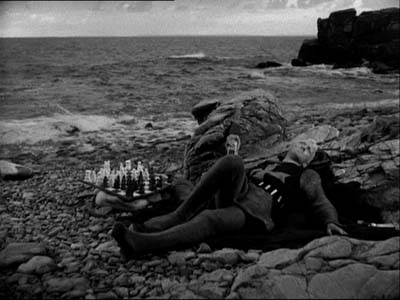


         The 1957 Swedish film, The Seventh Seal, directed by Ingmar Bergman, is an inspiring, beautifully executed picture that discusses the meanings of life and death. (Wikipedia. The Seventh Seal) The film is edited brilliantly for its time period in cinematography. Even though The Seventh Seal is a black and white film, it contains imagery so potent that it beats a lot of the imagery produced in today’s Hollywood blockbusters. The film is edited with a rich use of symbolism and metaphor to accompany the plot.
http://www.dvdtimes.co.uk/protectedimage.php.image=NoelMegahey/seventhseal1.jpg_12122007&cachedimage=true&width=400
                                              

                                              Analysis of the fist two minutes of the film:

·      The opening scene begins with a wide shot of the stormy sky. The sky has a powerful light of the sun coming through an opening in the clouds. The shot is escorted by loud, breath-taking sound of the orchestra. A viewer seeing this picture for the first time may make an association to God after being exposed to such a powerful scene. However such an association may fade as the viewer witnesses the second shot.
·       The use of Continuity Editing reoccurs all throughout the opening scenes. (Corrigan and White. P 149)
·      In the second shot, the image of the sky is slowly replaced with an image of a black silhouette of a bird (possibly an eagle.) The bird is freely floating through the air. Perhaps such image is intended to suggest an idea of a chase or the presence of death (Possibly the Grim Reaper or even the Black Plague). The bird’s dark wings are a metaphor to Grim Reaper's black cloak.
·      The third shot is an Extreme Wide Shot (Media College. Shot types) of the landscape. This shot is especially interesting because it is used to divide the landscape into a ying yang-like shape; where the land becomes the dark and the water becomes the light. Through such imagery, the editor suggests the presence of two reoccurring themes in the film: good and evil, or life and death. A similar pattern is repeated in the next shot, which is taken from a High Angle, (Media Shots. Shot Types) from the top of the mountain, overlooking the beach. The editor takes full advantage of the privileges of black and white cinema, as he experiments with the contrasts in volume and manipulation of artificial and natural light. 
·      The next two shots are done in a similar manner to each other. Using Wide Shots (Media Shots. Shot Types), two of the main characters are introduced into the scene. In each shot, they both appear to be either dead or sleeping. They are displayed in the light. This time the contrast between the beach and the water is reversed. The water appears to be darker than the beach. The significance of the ocean in this particular part of the scene is to indicate through the rhythmic sound of its waves the possibility of the characters breathing. The repetition of the sound of the waves crashing into the shore is intended to points to out that the knight and the squire must still be live.
·       The shot that follows next, introduces the idea of a journey that may lie ahead. The composition within the shot,  displays two horses, which represent journey.
·      Next, the camera fades into a close up of the knight who is holding on to his sword. This reveals his occupation and the fact that he is in distress.

  •      Next, follows a Close Up (Mediaknowall) on the knight’s companion, squire. The squire appears to be exhausted and barely moving, however he also hold on his dagger. 
  •           After that follows a montage sequence (Corrigan and White. P. 139) The montage sequence  is very important to the introduction of the main theme of the film.
Montage (consists of 4 parts) :

  1.          Starting with a Wide Shot (Media Shots) of the Knight walking toward the light surface of the water to wash off. 
  2.      Then, the use of a Very Wide Shot captures him walking in the direction of the viewer, away from the sea. The sea, in this shot is once again displayed as dark colored. Perhaps this is yet another suggestion of the conflict between life and death
  3.      The third shot if the sequence shows the knight on his knees, praying. Which introduces a religious element into the scene. 
  4.      And the final part of the sequence, shows the knight walking toward the beach again, however as soon as he gets closer the camera merges to the right and focuses on the chess board, that is rests on the rocks. Te chess pieces are also black and white. 

   
                                                     Work Cited


"Camera Angles." Mediaknowall. Web. 25 May 2011. <http://www.mediaknowall.com/camangles.html>.
"Camera Shots." Media College - Video, Audio and Multimedia Resources. Web. 25 May 2011. <http://www.mediacollege.com/video/shots/>.
Corrigan, Timothy, and Patricia White. Film Experience: an Introduction. New York, NY: Bedford/St. Martins, 2009. Print.
"Google Images." Google. Web. 25 May 2011. <http://www.google.com/imgres?imgurl=http://g-ecx.images-amazon.com/images/G/01/dvd/afaddis/image/SeventhSeal4.jpg>.
"Google Images." Google. Web. 25 May 2011. <http://www.google.com/imgres?imgurl=http://www.dvdtimes.co.uk/protectedimage.php?image=NoelMegahey/seventhseal1.jpg_12122007&cachedimage=true&width=400>.
"The Seventh Seal." Wikipedia, the Free Encyclopedia. Web. 25 May 2011. <http://en.wikipedia.org/wiki/The_Seventh_Seal>.
"YouTube - Ingmar Bergman - The Seventh Seal ‏." YouTube - Broadcast Yourself. Web. 25 May 2011. <http://www.youtube.com/watch?v=HtqB2XO9jtI>.

Friday, May 13, 2011

The American


                                                                    Movie Trailer


    Anton Corbijn’s 2010 film, The American, is impressive for its plot content and for its aesthetic beauty. The film focuses on character development of the main hero, Jack, or Mr. Butterfly played by George Clooney. The location, chosen for this picture, enters into a dialogue with the main character. The lone, rocky and rugged terrain of Italy’s countryside is intended to be a harmonious accompaniment to character development of lonely and mysterious professional assassin, Mr. Butterly. Similarly to a province that is tucked away from the rest of Italy’s flurry, Mr. Butterfly is isolated from the world and is lost within his own thoughts. He is filled with anxiety and paranoia. He seeks redemption to his actions, and hopes to turn his life around. According to the film’s director The American is intended to have a strong Western feel. (Focus features. The American: The Production.)
   “The look, the stories, the morality of movie Westerns always attracted me. Although The American is not actually a Western, it is structured in that genre; a stranger comes to a small town and connects with a couple of the people in it, but his past catches up with him – and there is a shootout.” – Director Anton Corbijn. (Focus Features. The American: The Production)
 The guidelines for a Western require a linear narrative, based around one story, which revolves around one character. The American fits these guidelines superbly, thanks to Rowan Joffe’s screenplay, adapted from Martin Booth’s 1990 novel “A Very Private Gentleman”. (Focus Features. The American. The Synopsis.)
    “With a Western in mind, I wove together my favorite passages from the book, simplifying the overall structure into a character-motivated thriller with a streamlined plot, a powerful redemptive theme, very spare dialogue, and a wild Italian landscape that acts like a character in its own right, exerting its transformative, melancholy beauty on our hero and assisting him in his journey to redemption. George Clooney’s interest in my first draft allowed me to continue refining subsequent drafts with him in mind; that was a considerable dramatic boon for the script as well as a rare opportunity to craft a character for one of the greatest movie actors alive.” – Screenwriter Rowan Joffe. (Focus Pictures. The American: The Production.)
   To pursue the norms of a Western genre, Anton Corbijn uses typical visual elements of a Western, like long extended shot, wide shots of the landscape, solemn music and a muted pallet throughout the film. With all if the elements combined and worked from the perspectives of cinematographer, Martin Ruhe, and editor Andrew Hulme, (The International Movie Base. The American: Full cast and crew.) The story preserves its authentic Western vibe even though it is set in a picturesque European location.
    “Because Anton comes from the world of photography, he is able to compose his frames in a striking way – something that many directors spend their entire careers striving to achieve. But he also brings a perspective where he doesn’t see anything straight on; everything comes from a bit of an odd angle, which is a plus.” – Produces Grant Heslov (Focus Features. The American: The Production.)
    
                                                         Work Cited

“The American | Focus Features | Inside Our Movies | The American: About The Production." Focus Features | Welcome to Focus Features | The World's Best Pictures. Web. 13 May 2011. <http://www.focusfeatures.com/article/the_american__about_the_production?film=the_american>.
"The American (2010) - Full Cast and Crew." The Internet Movie Database (IMDb). Web. 13 May 2011. <http://www.imdb.com/title/tt1440728/fullcredits>.
"Google Images." Google. Web. 13 May 2011. <http://www.google.com/imgres?imgurl=http://www.filmofilia.com/wp-content/uploads/2010/06/the_american_pm.jpg>.
"YouTube - ‪'The American' Trailer HD‬‏." YouTube - Broadcast Yourself. Web. 13 May 2011. <http://www.youtube.com/watch?v=4ywmoXZwkA0>.

Monday, March 21, 2011

Week 6. Meshes of the Afternoon by Maya Daren and Alexander Hammid.


Associative Organization.


“Associative Organizations explore psychological or formal resonances, either through metaphoric imager of symbolic concepts, and give many films a dreamlike quality that engages viewer’s emotions and curiosity.” (Corrigan and White p. 131.)


Meshes Of The Afternoon.


                                                                  Source:

                                http://www.youtube.com/watch?v=4S03Aw5HULU


 The Dreamlike quality of The Meshes of the Afternoon 1943, by Maya Daren, is compelling and puzzling. It explores anxiety and subconscious thought. I feel though the film is intended to carry out a strong feminist message. It is about a woman’s secret desires to escape the feeling of suppression in a male-dominated society. The metaphors and symbolism in The Meshes of the Afternoon are easy to identify with because of the familiarity of the element used to express them.

Symbolism in The Meshes of the Afternoon:

·      A knife is shown as both, a household item and a potential weapon, it suggests the presence of violence in the household.
·      Found broken mirror shards also suggests that the given household contains violence. And the shapes of the shards are intended to look similar to a knife.
·      A flower symbolizes femininity and fragility in the beginning of the film. As the flower is being placed on the bed, the viewer relates the given gesture to a flower being placed on a grave, bringing death onto the equation. And as that exact flower is turned into a knife, it becomes an indicator that femininity can either be harmed or become harmful. Perhaps it is a clue to the actuality of events. The main heroine’s way of self-destructing as appose being murdered.
·      The introduction of a key in the beginning of the film is used to demonstrate the act of entering the unconscious. It also symbolizes a pathway from actuality and to dream state. As the key is turned into a knife it becomes an indicator that perhaps in the heroine’s case, death is the only possible way to escape her situation.
·      The window in the film is a symbol of containment, and the feeling of being tied down or domesticated. It could also be an indicator that she inflicts the containment upon her own self, as though she is mentally disturbed.
·      The concept of chasing own death is introduced as the main character repeatedly follows a figure, which later on is revealed as Grip Reaper. And the idea of suicide or any form of self-inflicted violence is proposed as the viewer sees a mirror in the place of Grim Reapers face.
·      Multiples and Repetition are used to describe the heroine as someone that is overwhelmed with suspicious. She is torn, and has developed multiple perspectives on a single situation, and is unable to figure out which scenario is real.
·      As she approaches her sleeping self with a dagger, you see her footsteps land on four different surfaces; such as the sand, the water, the grass and that pavement. None but the very last footstep take place indoors. That suggests that she is eager to escape her containment. Ready to release herself into the wild.


                                                 Work Cited


Corrigan, Timothy, and Patricia White. Film experience: an introduction. New York, NY: Bedford/St. Martins, 2009.
"Google Images." Google. 21 Mar. 2011 <http://www.google.com/imgres?imgurl=http://4.bp.blogspot.com/-d1L1Bv9iPwY/TZyHpd4dR4I/AAAAAAAAAEE/-oEMsOaZ2iY/s1600/Maya-Deren-Meshes-of-the-Afternoon-film-stills.jpg>.
"YouTube - Maya Deren - Meshes of the Afternoon (1943) ‏." YouTube - Broadcast Yourself. 23 Mar. 2011 <http://www.youtube.com/watch?v=4S03Aw5HULU>.


Wednesday, March 9, 2011

Week 5 Restrepo

http://www.youtube.com/watch?v=zvUdruvbdmI&feature=player_embedded

Social, Historical and Political Documentary

         Restrepo is a documentary film by Tim Hethringtin and Sebastian Junger that is shot in the Korengal Valley in Afghanistan. The film focuses on a group of American soldiers that spend fifteen month in the deadliest posting in the United States military.  The documentary has an absurdly realistic feel to it. It is shot from the perspective of the soldiers, and it follows their narration. The viewer feels though he/she is a part of the ongoing combat, death, fear, despair, and pain that the Restrepo platoon has to live through everyday.
   Personally, I find it to be very difficult to identify the genre of this documentary. The only way that I can ever come close to doing so, is by breaking it down into three different categories: social, historical, and political.
   The Social aspect of Rertrepo comes out as the viewer is introduced to the natives of the region, where he/she receives an inside look into their styles of living. The viewer becomes familiarized with the mountain landscape of the region, the traditional clothing of the natives, the Islamic practices, the poverty and the hostile situations that the natives live in.  The film provides a fantastic description of the negotiation process between the Afghani civilians and the American soldiers, where the two opposite cultures meet to try to work out their differences and to discuss the ways in which they can either hurt or benefit one another.
    The Historical aspect of the documentary lies within the undeniable connection of Afghanistan War to the even of September 11. Though it is not verbally discussed in the film, the weight of 9/11 lies heavy upon this nation. The viewer of this documentary should already be familiar with the history of American War on Terrorism following the al Qaida attack on the Unites States in 2001.
     Though the film never provides any information on the political officials that stand behind the Afghanistan War, or does is discuss the American standpoint at all, Restrepo without a doubt is a political film. The Afghanistan War, as well as the Iraq War, is the making of American diplomats; however they are not the ones who put their lives on the line to fight for this nation. What the viewer sees in the film is the aftermath of political decision-making. The chaos, the death and the killings are all the aftermath of diplomacy.
    Seeing Restrepo is an unbelievable, mind-expanding experience. The film provides the kind of insight on military life that I have never had the chance to witness before. It describes with honestly the hardships of American soldier. It paints a portrait of human beings both emotional and emotionless, in a situation of life or death during a period of fifteen-month deployment. You cannot help it but feel troubled by this film. It raises questions such as: What is it all for? And what is it all worth? Can this war even be won? And whose is there to blame for it? Thought the film never provides the answers, it raises a great deal of awareness and hope that someday these questions will get answered.

Monday, February 21, 2011

Week 4 Social Network


                                                         Linear Chronology

Every narrative film has a starting point. Sometimes a plot of a film is organized to follow a chronological order, where all the events occur one after another in a linear pattern; and in other cases, the first scene of the film is set at an important point in the plot, which is not always the beginning of the story. For instance, David Fincher’s  Social Network takes place at two interrelated court hearings, where the main character, Mark Zuckerberg reflects on the chronology of the creation process of his mega network. The majority of the film is a description of Mark’s path through his career; staring with a vivid depiction of the character, followed by a sequential order of his actions, and a summary of his accomplishments. The depiction of the character is presented in the Bar Date scene, where the viewer gets to witness Mark’s not-so-pleasant side. He is revealed as an extremely ambitious person with arrogant qualities, and tendencies to argue and put his brilliance on a pedestal. The sequential order of his actions touches up on the topics of friendship, betrayal, decision-making, and determination, described in the scenes involving Eduardo Saverin. And the summary of his accomplishments is discussed during the scenes of court hearings. Though the court room scenes become the main setting of the movie because they take place in a present time, linear chronology is introduced through the hearing themselves, which contains a series of action that take place throughout an extended period of time.
    Babel by Alejandro Gonzales Inarritu, has an entirely different form or Narration.
It is a story of four separate groups of people, with different cultural backgrounds that exist in a tremendous expanse in the world. They become ironically linked to a single tragic event. Aside from the event itself, the lives of the characters are individually filled with pain and suffering. Babel is a film about predetermined connection, not only through the course of events but also through the universal understanding of human emotion. To depict that, Alejandro Gonzales Inarritu breaks down the typical expectations of linear plot. He provides the viewer with a fantastic explanation to every character’s story and their contribution to the main event, but he does it in a manner that is sporadic. Each group is introduces at a different point on a timeline, and is separated by a great amount of distance. This way each story is equally unique and touching. And the greater connection becomes even more effective as he introduces the viewer to the contributing elements of each group.  To the elements’ individual insignificance and their power as a whole.

Saturday, February 5, 2011

Week 2 The Flags of our Fathers


Identification and Cognition.

Before I had seen the full version of
The Flags of out Fathers and not just the theatrical trailer, I was under the impression that the film was going to be somewhat of a war epic. I was excited about the World War II film, due to the fact that both of my grandparents were veterans of the war. I grew up hearing stories about Russia’s notorious Red Army, and was always fascinated with World War II literature.  Also, I enjoyed the previous performances of the selected cast members, as well as Clint Eastwood’s other films, and I had a tremendous amount of respect for Steven Spielberg as a producer. From the first look at the trailer, I was excited to see the film, however with the viewing of it, my excitement was lost, almost completely. I was not disappointed with the story behind this motion picture, as much as I was disappointed with the way it was executed.  I felt though the film was a bit prolonged.  At times, the dialogue and the narrative were needlessly extensive, which made the film difficult to watch. I began to lose my interest half way through this 123-minute movie. Perhaps I shouldn’t entirely write it off, as it might have been intended for a different audience, the kind that had more of a direct involvement in the War.
   In the case of The Flags of out Fathers, Identification and Cognition play a tremendous role. According to Corrigan and White (pg. 19) “Identification at the movies suggests a complex process by which we empathize with, project onto, or participate in a place, action, or a character- whether separately or as these elements interact.” Therefore personally, I identify with the film through the stories that were shared by my grandparents, through other motion pictures, poetry and books that discuss the subject of World War II. I also identify with the general interest in actors like Ryan Phillippe and his performances in Crash and Stop-Loss, and Barry Pepper, and his work in Saving Private Ryan. Familiarity with these actors made me more open to seeing the film, as I did not feel disappointed in their achievement prior to seeing this picture.  However the biggest element of the plot, the raising the American Flag on Iwo Jima, was something that I was not entirely familiar with. Though I had seen the photograph in the past, I was never affected by the event, and had no knowledge of the tremendous influence that it had on the American history. Perhaps the film was intended to educate those, like myself, on the subject, and in a way it did, but as far as the movie experience goes, I was too distracted by how long it took the director to get his point across, as appose to the message that he was trying to portay. And quite frankly I couldn’t wait for the film to end because after a while the message was beginning to become very redundant.
  Cognition, for an audience that was directly affected by the War and had a good understanding of the importance of the event, may very well have had turned the viewing of this film into a pleasant experience. As explained by Corrigan and White (pg.19) “Cognitive process of watching a movie involves the intellectual activities of comparison and comprehension.” From the perspective of a person, that was able to better relate to the film, The Flags of Our Fathers, could have served as strong reminder to the extensive pains and horrors of the War. Those that Emotionally relating to the unfortunate scenario that the main characters of the film find themselves in, may treat this picture as monument to the lost soldiers or the War.